

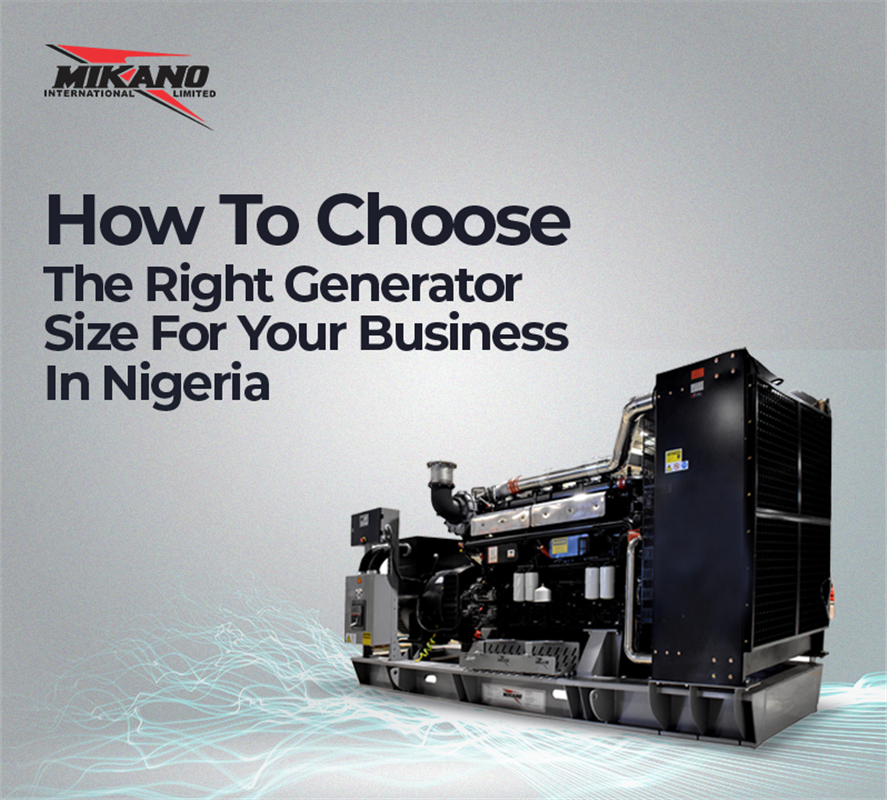
Choosing the right generator size is critical for business uptime. This guide explains how Nigerian businesses can calculate power needs and avoid costly mistakes.
Introduction
Reliable power is not optional for businesses operating in Nigeria. From factories and hospitals to offices and retail spaces, the right generator size determines whether operations run smoothly or suffer costly interruptions.
Yet, one of the most common mistakes businesses make is choosing a generator that is either too small to handle demand or too large and inefficient to run cost-effectively.
This guide breaks down, in clear and practical terms, how to choose the right generator size for your business, without guesswork.
Why Generator Size Matters
Generator size directly affects:
Operational reliability – Undersized generators overload and fail prematurely
Fuel efficiency – Oversized generators consume more diesel than necessary
Equipment lifespan – Incorrect sizing leads to wear and frequent breakdowns
Total cost of ownership – Poor choices increase maintenance and running costs
Getting the size right is about balance, not excess.
.png)
Step 1: Understand Your Power Load
Start by identifying all the equipment your business runs during normal operations.
This typically includes:
Lighting
Air conditioning systems
Machinery or production equipment
IT infrastructure and servers
Elevators, pumps, or compressors (where applicable)
Each device has a power rating, usually measured in watts (W) or kilowatts (kW). These values are found on equipment nameplates or manuals.
Step 2: Calculate Total Running Load
Add up the power ratings of all equipment that will run simultaneously.
For example:
Lighting: 5 kW
Air conditioning: 15 kW
Production equipment: 20 kW
Total running load = 40 kW
This figure represents the minimum power your generator must support continuously.
Step 3: Account for Starting Load
Some equipment, especially motors, compressors, and heavy machinery, requires extra power at startup.
This surge, known as starting or peak load, can be 2-3 times higher than normal running power.
Ignoring this step is one of the biggest causes of generator failure.
A safe approach is to add a 20-30% buffer to your total running load.
Using the example above:
40 kW + 30% buffer = 52 kW
Step 4: Convert kW to kVA
Generators are rated in kVA (kilovolt-ampere), not kW.
In Nigeria, most commercial generators operate at a power factor of 0.8.
kVA = kW ÷ 0.8
So:
52 kW ÷ 0.8 = 65 kVA
This means a 65 kVA generator would be appropriate for this business.
Step 5: Consider Business Growth
A generator should not only meet today’s needs but also accommodate future expansion.
Ask:
Will more equipment be added in the next 2-5 years?
Will operating hours increase?
Will production capacity grow?
Choosing a generator with controlled headroom avoids premature replacement while keeping fuel efficiency in check.
Residential vs Commercial vs Industrial Needs
Homes & small offices: Typically require 10-60 kVA depending on appliances
SMEs & estates: Often fall within 60-250 kVA
Industrial facilities & IPPs: Range from 500 kVA to multiple megawatts
This is where professional assessment becomes essential, especially for larger installations.
The Role of Professional Assessment
While basic calculations help, real-world conditions such as:
Load diversity
Power quality requirements
Noise control
Space constraints
Fuel consumption targets
must be professionally evaluated.
A proper assessment ensures the generator selected delivers reliability, efficiency, and long-term value.
Final Thoughts
Choosing the right generator size is not about buying the biggest option available. It is about understanding your power needs and matching them with a solution designed to perform consistently under Nigerian operating conditions.
When properly sized, a generator becomes an asset, not a liability.
Frequently Asked Questions About Generator Capacity
What's the difference between kVA and kW?
kVA is the total generator capacity, while kW is the usable power (usually ~80% of kVA for most business applications). Focus on kVA when choosing a generator.
How long will a Mikano generator last?
With proper maintenance, Mikano generators last 15-25 years or 20,000-30,000 operating hours. Regular servicing every 100-200 hours ensures peak performance.
How much does a 30 kVA generator cost in Nigeria?
The cost of a 30 kVA Mikano generator depends on factors like engine type (Yorc, MTU, Perkins), soundproofing, and additional features such as automatic transfer switches. For exact pricing and options, reach out to a Mikano International sales agent, who will provide all the information you need.